
Garden Amphorae Decoration Ideas for Elegant Gardens
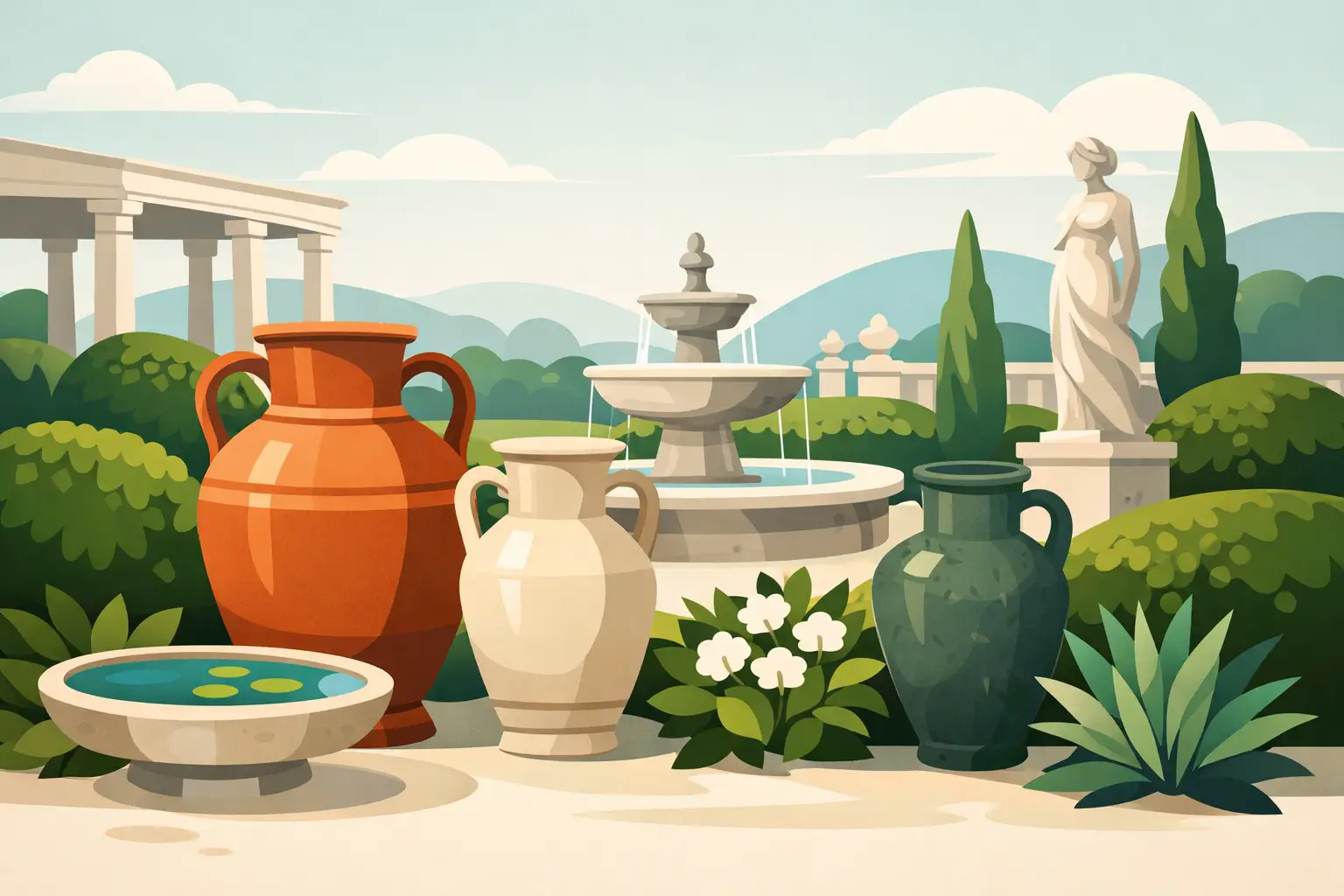
A large amphora does not work by its price, but by its space. If it stands lost in a corner, even handcrafted terracotta remains just a vessel. If, on the other hand, it is given space, suitable planting and a relationship to the architecture, the impression of a grown Mediterranean property is created. This is exactly what high-quality garden amphorae decoration ideas are aimed at: lasting effect instead of short-term seasonal decoration.
An original Italian Terracotta Amphora brings more to it than colour and volume. Its handcrafted surface, the strong wall and the natural patina give terraces, courtyards or garden axes a presence that can hardly be achieved with light mass-produced goods. However, it is not the amount of decoration that is decisive, but the staging.
Garden Amphora Decoration Ideas with Architectural Impact
Amphorae are among the oldest and at the same time most effective garden objects. Their shape is classical, but not automatically historicizing. Whether they appear Mediterranean, strictly symmetrical or deliberately natural depends on location, size and planting. If you think these three factors together, you create an eye-catcher with substance.
Designing the entrance area as a prelude
Two identical amphorae to the right and left of a front door, a courtyard gate or a wide staircase immediately create order. This solution is particularly suitable for country houses, villas, restored old buildings and representative commercial properties. The dimension is important: small vessels next to a high portal appear hesitant. An amphora should frame the entrance, not disappear in front of it.
Boxwood, ilex, yew or spherically cut laurel shapes are suitable for a formal design. In sheltered locations, olive trees or citrus plants also set a Mediterranean accent. If you prefer a seasonally changing impression, combine white daffodils in spring, scented pelargoniums in summer and structurally strong grasses in autumn. The container itself remains the constant.
Make sure that the surface is quiet and made of natural stone, gravel or clearly laid slabs. A magnificent amphora next to plastic furniture, visible cables or a collection of small pots will lose its effect. Fewer accompanying objects create more value.
Closing a line of sight in the garden
Long lawns, paths, and formal garden spaces need a destination. A large amphora on a pedestal at the end of a visual axis fulfills this task with astonishing clarity. It draws the eye without the need for a statue or an elaborate water basin.
Here, the amphora can also be left unplanted. Especially on a pedestal, between trimmed hedges or in front of a warm brick wall, an open amphora shows its full sculptural power. A subtle patina is desirable, because it allows the object to grow credibly into the plant. If you are planting, you should opt for a single strong shape: for example, agapanthus, tall grasses or a compact periwinkle ball.
The right height determines the long-distance effect. A low vessel disappears behind perennials, while an amphora on a matching terracotta base remains legible even from a greater distance. For spacious properties, it is therefore worthwhile to use a deliberately generous format.
Terrace and loggia Mediterranean frame
On terraces, the amphora works best as a spatial bracket. Instead of placing many small containers along the wall of the house, two to four selected large containers mark transitions: the beginning of a seating area, the edge of an outdoor staircase or the path from the house to the garden.
For sunny terraces, lavender, rosemary, sage and olives are classic partners. Their silvery-green foliage emphasizes the warm tone of real terracotta particularly convincingly. With generous amphorae, the planting can be a little more restrained. A single old olive tree or a strong rosemary trunk looks more confident than an overcrowded mixed arrangement.
Where children play or large groups regularly need space, amphorae should not be placed as a bottleneck in the walkway. Place them on the outer edges of the terrace or next to steps. This keeps the area practical and still gains character.
Garden amphorae decoration ideas for beds and walls
In loosely designed country house gardens, an amphora does not necessarily have to be strictly placed. Half-integrated into a perennial plantation, in front of a natural stone wall or at the edge of a gravel bed, it can look as if it has been part of the garden for decades. This design thrives on contrasts: the calm, heavy form of the amphora meets moving grasses, roses, sage and perennials.
A reclining amphora is an attractive variant, but requires restraint. It should not look like a container that has fallen over by chance, but should be deliberately integrated into an embankment, a gravel strip or a Mediterranean planting. Plants close to the ground such as thyme, sedum or hanging rosemary can grow from its opening. This idea is usually less suitable for small urban gardens because it takes up space and quickly looks artificial if too many decorative elements are added.
On a garden wall, individual amphorae set by far stronger accents than a complete row. The combination of warm terracotta, light limestone and dark green foliage is particularly beautiful. Ferns, hosta or ivy can also be used in shady areas. Mediterranean planting is not mandatory if the architecture or lighting conditions require otherwise.
Water as a calm counterpoint
Amphorae and water belong together in terms of design, but a water feature should correspond to the size of the vessel. A stately amphora next to a tiny solar fountain looks arbitrary. A quiet pool is more harmonious, a wall fountain or a single amphora as part of a clearly defined water element.
With this variant, the material quality is of particular importance. Permanent moisture, frost and temperature fluctuations place greater demands on containers than a sheltered patio area. Original Impruneta Terracotta is known for its dense, high-fir quality and is available from Impruneta.de with a lifetime guarantee against frost damage. This is a decisive difference for permanently installed garden objects compared to decorative imported goods without a resilient origin.
Choosing the right size, material and patina
An amphora should not have to look new to be of high quality. Real terracotta develops its own surface outdoors. Rain, traces of limescale, algae growth and sun change the colour tone slowly and individually. This patina is part of the character of the material, as long as it is not caused by incorrect care or standing moisture.
Avoid aggressive cleaners, varnishes and artificially applied ageing effects. They take away the natural appearance of the clay. In most cases, it is sufficient to remove loose leaves and soil with water and a soft brush. In the case of planted amphorae, a suitable water drainage and a stable, level location are more important than any subsequent care.
The proportion to the surroundings also deserves attention. For a narrow balcony, a monumental amphora is not the best choice, even if it is visually impressive. Conversely, a wide staircase or a large courtyard needs volume so that the design does not appear small-scale. As a guide, the stronger the architecture, the clearer and larger the vessel may appear.
The most common mistakes in amphora decoration
The most common mistake is overdecoration. Amphorae do not need garlands, figures, artificial flowers or changing accessories to attract attention. Their shape, material and craftsmanship are already statement enough.
Equally problematic is an inconsistent mix of styles. A classic terracotta amphora can complement modern architecture very well if there are repetitions: for example, through natural stone, warm wooden surfaces or other vessels in related earth tones. Between colourfully glazed pots, plastic furniture and garish decorative elements, on the other hand, it loses its design authority.
If you want to use several amphorae, you should work with a family of shapes. Different sizes of the same design create depth and order. Too many different ornaments, colours and heights quickly make the garden look like an exhibition, not like a grown place.
An amphora becomes a defining garden object when it does not need to be decorated, but is decoration itself. Give it a location with meaning, choose a planting with tranquility and give real material the time to tell its own story.
